


‹
›
‹
›
Structural steel (or "section steel") refers to steel products with specific cross-sectional shapes and dimensions; it is one of the four major categories of steel products (alongside plates, pipes/tubes, and wire). Based on their cross-sectional geometry, structural steel products are classified into simple-section and complex-section (or "special-profile") types. The former includes square, round, flat, angle, and hexagonal bars, while the latter encompasses I-beams, channel steel, rails, window-frame profiles, and bent/formed sections.
Classification:
Depending on the quality of the steelmaking process, structural steel is categorized into ordinary structural steel and high-quality structural steel. According to current metal product catalogs, ordinary structural steel is further subdivided into large, medium, and small sections. Based on cross-sectional shape, these can also be classified as I-beams, channel steel, angle steel, round bars, etc.
Large-section steel: Within this category, I-beams, channel steel, angle steel, and flat bars are typically hot-rolled. Round, square, and hexagonal bars may be produced via hot-rolling, forging, or cold-drawing.
I-beams, channel steel, and angle steel are widely used in industrial construction and metal structures—such as factory buildings, bridges, ships, agricultural machinery, power transmission towers, and transport equipment—often in combination with one another. Flat bars are used in construction for applications like bridge components, building frames, fencing, and the fabrication of ships and vehicles. Round and square bars serve as raw material for various mechanical parts, agricultural machinery components, and tools.
Medium-section steel: This category includes I-beams, channel steel, angle steel, round bars, and flat bars, which serve purposes similar to those of large-section steel.
Small-section steel: This category includes angle, round, square, and flat bars; their processing methods and applications are similar to those of large-section steel. Small-diameter round bars are frequently used as reinforcing steel (rebar) in construction.
Characteristics:
Application features of H-beam steel:
Hot-rolled H-beam steel features an optimized ratio of section height to width, tailored to specific application requirements, which results in excellent mechanical properties and superior functional performance.
It offers great flexibility and a wide range of options for structural design. For a given beam depth, steel structures allow for spans up to 50% larger than those of concrete structures, offering greater flexibility in architectural layout.
Steel structures are lightweight. Their lower self-weight reduces internal design forces, which in turn lowers requirements for foundation treatment, simplifies construction, and reduces costs.
Steel structures based on hot-rolled H-section steel are scientifically and rationally designed; they exhibit excellent ductility, flexibility, and high structural stability. They are well-suited for buildings subject to significant vibration or impact loads and offer strong resistance to natural disasters—making them particularly ideal for structures in earthquake-prone regions. Statistics from major, devastating earthquakes (magnitude 7.0 or higher) worldwide show that buildings utilizing H-section steel frameworks sustain less damage.
Steel structures increase the effective usable floor area. Because the cross-sectional area of steel columns is smaller than that of concrete columns, the usable floor area can be increased by 4% to 6%, depending on the building type.
Compared to welded H-section steel, hot-rolled H-section steel significantly saves labor and materials, reduces the consumption of raw resources and energy, results in lower residual stress, and offers superior surface quality and appearance.
These structures are easy to machine, connect, and install, and they are also simple to dismantle and reuse.
The use of H-section steel contributes to environmental protection in three key ways: First, it enables "dry" construction methods, which generate less noise and dust compared to concrete-based construction. Second, the reduced self-weight requires less excavation for foundations, minimizing land disruption; furthermore, the significant reduction in concrete usage—and the corresponding decrease in quarrying and stone extraction—helps preserve the ecological environment. Third, at the end of a building's service life, the dismantling process generates minimal solid waste, and the recovered steel has high recycling value.
Steel structures—particularly those based on hot-rolled H-section steel—benefit from a high degree of industrialization. They are well-suited for mechanized, intensive production, offering high precision, ease of installation, and consistent quality. This facilitates the establishment of specialized manufacturing facilities for buildings, bridges, and industrial plants. The development of steel structures has fostered and driven the growth of hundreds of emerging industries. Construction using these materials is rapid, requires a smaller footprint, and is suitable for all-weather operations, as it is minimally affected by climatic conditions. Steel structures built with hot-rolled H-section steel can be erected 2–3 times faster than concrete structures; this accelerates capital turnover and reduces financial costs, ultimately leading to investment savings. A notable example is the Jin Mao Tower in Pudong, Shanghai: the main structure—nearly 400 meters tall—reached its topping-out stage in less than six months, whereas a comparable steel-concrete composite structure would have required a two-year construction period.[1]
Characteristics and Applications of Angle Steel
Angle steel, commonly known as "angle iron," consists of long steel bars with two sides perpendicular to each other. It is categorized into equal-leg and unequal-leg angle steel. For equal-leg angle steel, both sides are of the same width; specifications are expressed in millimeters as "side width × side width × side thickness." For instance, "∠30×30×3" denotes an equal-leg angle with a side width of 30 mm and a side thickness of 3 mm. It can also be designated by a "size number" (or "model"), which corresponds to the side width in centimeters—for example, "∠3#." Since this size number does not specify the thickness, it is essential to provide the full dimensions (side width and thickness) in contracts and other documentation to avoid ambiguity. Hot-rolled equal-leg angle steel is available in sizes ranging from 2# to 20#. Angle steel can be configured into various load-bearing components or used as connectors between structural elements. It is widely employed in diverse building and engineering structures, including beams, bridges, power transmission towers, hoisting and transport machinery, ships, industrial furnaces, reaction towers, equipment racks, and warehouse shelving.
Characteristics and Applications of Channel Steel
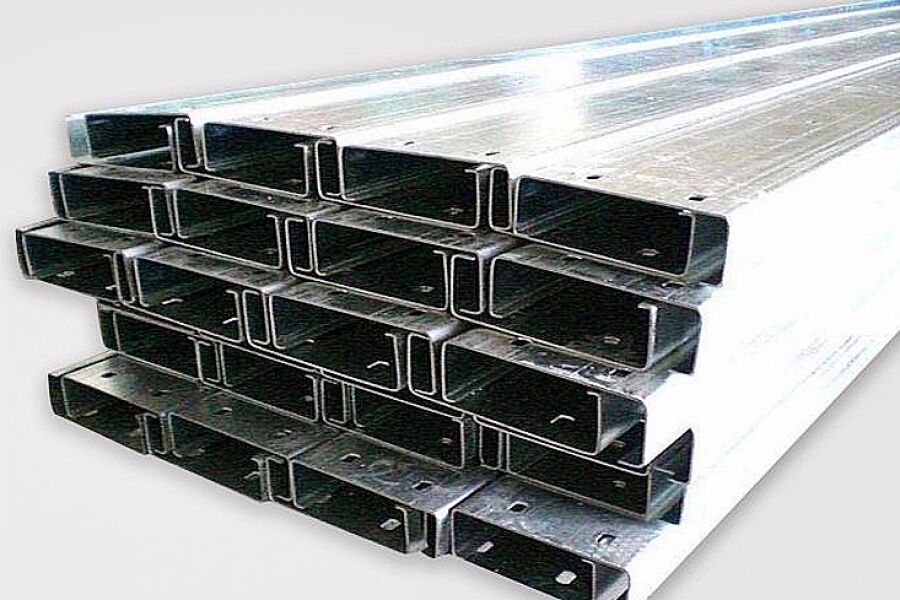
Channel steel consists of long steel bars with a U-shaped (grooved) cross-section. Its specifications are expressed as, for example, "120×53×5," which refers to a channel with a web height of 120 mm, a flange (leg) width of 53 mm, and a web thickness of 5 mm—also referred to as "12# channel steel." For channel steel sections with the same web height but varying flange widths and web thicknesses, the designations are differentiated by adding "a," "b," or "c" to the model number (e.g., 25a#, 25b#, 25c#). Channel steel is categorized into standard and lightweight types. Hot-rolled standard channel steel comes in sizes ranging from 5# to 40#, while hot-rolled standard channel steel supplied by special agreement between the supplier and the buyer is available in sizes from 6.5# to 30#. Channel steel is primarily used in building structures, vehicle manufacturing, and other industrial frameworks; it is also frequently employed in conjunction with I-beams.
Application Characteristics of I-beams
I-beams, also known as steel beams, are long steel sections with an I-shaped cross-section. Their specifications are defined by the web height (h), flange width (b), and web thickness (d) in millimeters—for example, "I 160×88×6" denotes an I-beam with a web height of 160 mm, a flange width of 88 mm, and a web thickness of 6 mm. I-beam specifications can also be expressed by a model number, which represents the web height in centimeters (e.g., I 16#). For I-beams with the same web height but different flange widths or web thicknesses, the designations are distinguished by adding "a," "b," or "c" to the model number (e.g., 32a#, 32b#, 32c#). I-beams are classified into standard and lightweight types; hot-rolled standard I-beams are available in sizes from 10# to 63#, while those supplied by special agreement between the supplier and the buyer range from 12# to 55#. I-beams are widely used in various building structures, bridges, vehicles, support frameworks, and machinery.
Application Characteristics of Cold-Formed Steel
Cold-formed steel is a primary material for constructing lightweight steel structures, produced by cold-bending steel plates or strips. This process allows for very thin wall thicknesses, significantly simplifies production, and enhances manufacturing efficiency. It enables the production of various profiles with uniform wall thickness but complex cross-sectional shapes—geometries that would be difficult to achieve using conventional hot-rolling methods—and can be manufactured from a diverse range of materials. In addition to their use in various building structures, cold-formed steel sections are also widely employed in fields such as vehicle manufacturing and the production of agricultural machinery.
Special-shaped steel sections include retaining rings, horseshoe-shaped steel, magnetic pole steel, presser foot plates, shallow-channel steel, small-channel steel, T-shaped steel, bulb flats, feed-dog steel, and hot-rolled hexagonal steel. Other types include rivet steel, steel for agricultural tools, and window-frame steel.[2]
Manufacturing Process
Processing workflow for welded H-beams: H-beam manufacturing process
Special-Purpose Steel Sections
Steel Reinforcement for Reinforced Concrete
These fall under the category of small-sized steel sections. They include hot-rolled round steel bars for reinforced concrete, heat-treated steel bars for prestressed concrete, and hot-rolled ribbed steel bars for reinforced concrete, as well as cold-worked ribbed steel bars. With the exception of round bars, these are also referred to as "deformed bars" (or "rebar"). During the rolling process, the surface of the steel is formed with protrusions or ribs; these are used as reinforcement for concrete in the construction industry. Based on their yield point and tensile strength, these steel bars are classified into grades I, II, and III.
Recommended for You

Online Consultation